
Wastewater and nutrient reuse
The wastewater reuse is a good practice, still low spread in Europe. This is due to a number of barriers, in particular legislative (especially in Italy) and cultural ones. A number of environmental and economic benefits could be reached with greater reuse of wastewater.
In line with circular economy principles, IRIDRA proposes, anytime is possible to, solutions voted to the reuse of wastewater, which would be better to be called "resource-water" due to the number of precious resources included into, not only water but, for instance, nutrients for crops and carbon for soils.
Advantages
- more water left to rivers and groundwater
- less water pollution
- reuse of nutrients and carbon in agriculture and re-inclusion of them in natural biogeochemical cycles
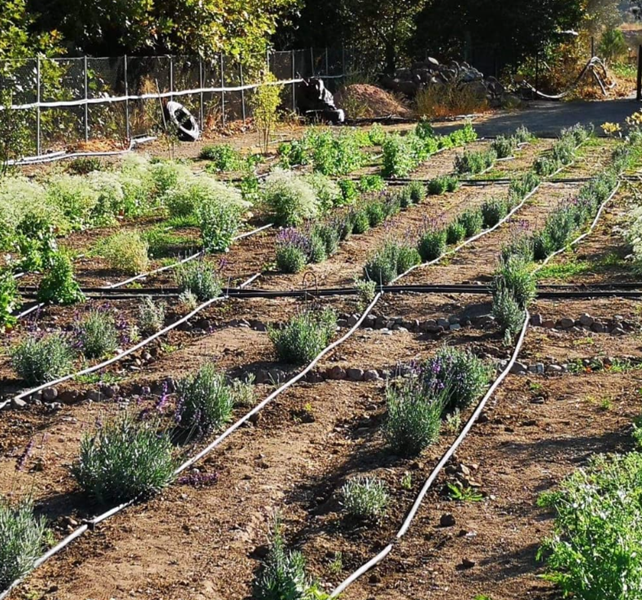
For nutrient recovery and wastewater reuse, IRIDRA proposes the following solutions
Constructed wetlands
- Fertigation through constructed wetlands (Hydrousa)
P2GreeN solutions
- Nutrient recovery from urine (liquid fertiliser), in collaboration with VunaNexus
- Nutrient recovery from urine (pellet fertiliser), in collaboration with Sanitation360
- Nutrient recovery from faeces (compost), in collaboration with Goldeimer
- Wastewater reclamation and reuse, in collaboration with BIOAZUL
Usually, wastewater is seen as a substance that has to put away as soon as possible. This idea has influenced the treatment techniques and has brought to conceive expensive purification solutions (big sewage net in pressure and activated sludge treatment plants), with energy waste and low reuse of nutrients and treated water. Also, the recycling of depuration sludge is often not possible due to the presence of toxic substances. Moreover, the common practice of municipalities of not separating the different types of wastewater makes not easy an inversion of tendency: black water with high organic and microbial content, easily treatable grey water and rainwater only initially polluted (the so-called "stormwater") are collected together in a single net and can not have a differentiated treatment.
The reuse of treated wastewater, for example in toilet flushing of in irrigation, reduces the fresh water consumption, which is an important factor in situations of the limited availability of water. At the same time, reducing the fresh water consumption brings an "at-the-source" reduction of the amount of wastewater to be treated. Treated wastewater to be reused has to respect different quality values from the ones for discharge in natural water bodies, and these values also change according to reuse aims. In the case of reuse, therefore, it will be necessary to adapt the treatment to the chosen utilization. One of the base requirements for safe reuse of wastewater is the hygienic-sanitary quality.
Reuse of wastewater in agriculture is a diffuse practice in many countries and it is more and more recommended by international agencies promoting sustainable development. Countries with the greatest experience are USA and Israel. In Israel since a long time used waters are considered part of the national water patrimony: already in 1970 quite 10% of water potential was constituted of wastewater. In USA the reuse of wastewater has great importance above all in the desert states of the south: in particular California and Texas. Just in California, the first laws about the regulation of quality standards for reuse of wastewater were approved.
Recently, with the raise of the environmental sensitivity in all the world, the theme of reuse of water is getting more and more diffuse: the World Water Council report on water in the 21° century (WWC 1998) cites formally the reuse of wastewater as a principal strategy to promote the utilization of "non-conventional" resources.
Constructed wetlands and wastewater reuse
In the field of wastewater reuse nature-based solutions such as constructed wetlands and waste stabilization ponds can play a relevant role as tertiary stages for the following reasons:
- high disinfection and removal of Endocrine Disrupting Chemicals (Masi et al. 2004)
- buffer capacity against conventional WWTPs malfunctioning
- possibility to work also as accumulation tanks, making the reuse during the seasons more suitable.

Nutrient recovery from urine
Nutrient recovery from urine represents one of the most promising strategies to support the transition from a linear wastewater management model towards a circular one, in which nitrogen (N) and phosphorus (P) are recovered and returned to the agricultural cycle. Urine contains a significant share of the nutrients excreted by humans and can be source-separated and treated through stabilisation and concentration processes to produce bio-based fertilisers. In this context, the European P2GreeN project develops and demonstrates solutions for the recovery of N and P from sanitary waste streams and their transformation into products for agricultural use. P2GreeN has demonstrated four circular sanitation solutions in its pilot regions: urine diversion and fertiliser recovery (Sanitation360, VunaNexus); faeces separation and composting (Goldeimer); and tertiary wastewater treatment for water reuse in irrigation and fertigation (Bioazul).
Within the P2GreeN project, IRIDRA conducted 8 Feasibility Studies to assess the replicability of P2GreeN solutions across the four follower regions in Italy, Hungary, Greece and France. The selected sites cover a wide range of contexts and typologies: portable urinal rental (Rolling Hygenic, Hungary); a municipal wastewater treatment plant, a university campus and a portable toilet service company (Greece); a motorway catering chain and an agricultural cooperative (Italy); and a research campus and a new urban district (France). For each case study, the technical feasibility of implementing one or more P2GreeN solutions was assessed, including preliminary sizing, engineering layouts and schematics, CAPEX/OPEX calculations, and estimates of the potential environmental benefits associated with the implementation of circular sanitation solutions.
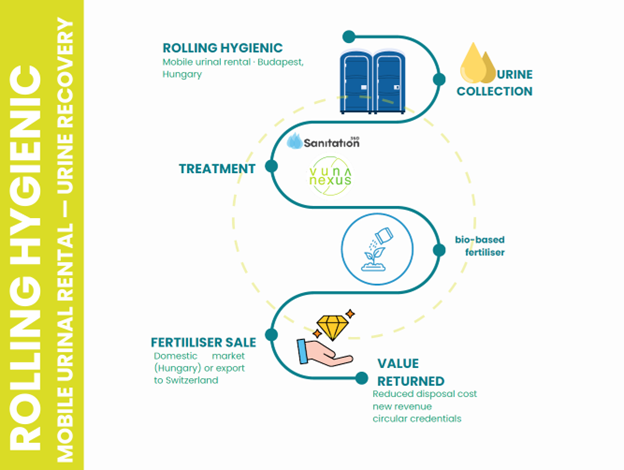
Process flow diagram for the Rolling Hygenic feasibility study, Hungarian follower region
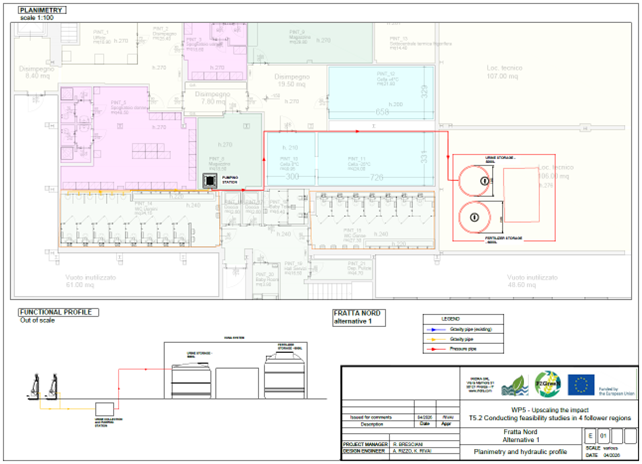
Preliminary layout and hydraulic profile of one of the feasibility studies (elaborated by IRIDRA)


